By clicking “Accept all”, you agree to storing cookies on your device to enhance site navigation, analyze site usage, and assist in our marketing efforts. More information can be found on "Manage cookies".
When you visit any website, it may store or retrieve information on your browser, mostly in the form of cookies. These “cookies” of information might be about you, your preferences, or your device, and they’re mostly used to make the site work as you expect it to. Cookies don’t usually directly identify you, but they can give you a more personalized web experience. Because we respect your right to privacy, you can choose not to allow some types of cookies. Click on the category headings to read more or change your default settings. (Note: Blocking some types of cookies may impact your experience on our site, as well as the services we can offer you.)
These cookies are necessary for our website to function and can’t be switched off in our systems. They’re set for you behind the scenes when you do things such as log in, fill out forms, make a request for services, or set your privacy preferences. You can set your browser to block or alert you about these cookies, but some parts of our site won’t work without them.
+Functional Cookies
These cookies enable our website to work smoothly and in a manner personalized to you. They may be set by us or by third-party providers whose services we’ve added to our pages. For example; downloading a customer service form using PDF. If these cookies are blocked, then some or all of these services may not function.
+Performance Cookies
These cookies allow us to count how many times people visit our website, and how they get here, so we can measure and improve its performance. They show us which pages are the most (and least) popular, and how visitors move around on the site when they’re here. If you don’t allow performance cookies, we have less information about how to improve our sites that will be useful to you.
+Marketing Cookies
These cookies may be set through our site by our advertising partners. They may be used by those companies to build a profile of your interests and show you relevant advertisements on other sites. If these cookies are blocked, you will experience less targeted advertising.
Understanding Why OT Cybersecurity is Critical for Federal and Government Facilities
At military installations and government-owned facilities, operational technology (OT) systems work 24/7 to monitor the physical systems and processes that sustain daily operations. Energy distribution systems, water and wastewater utilities, fuel storage and distribution, airfield lighting, and building control systems rely on OT to monitor and control critical processes in real time. As OT has become more advanced and interconnected, cyber threat actors have also become more sophisticated and deliberate in their tactics. What were once isolated control systems are now interconnected digital environments, making them targets for cyberattacks.
Having a robust OT cybersecurity framework in place helps to safeguard critical infrastructure from system breaches, shutdowns, physical damage, economic disruption, and threats to public safety and the environment.
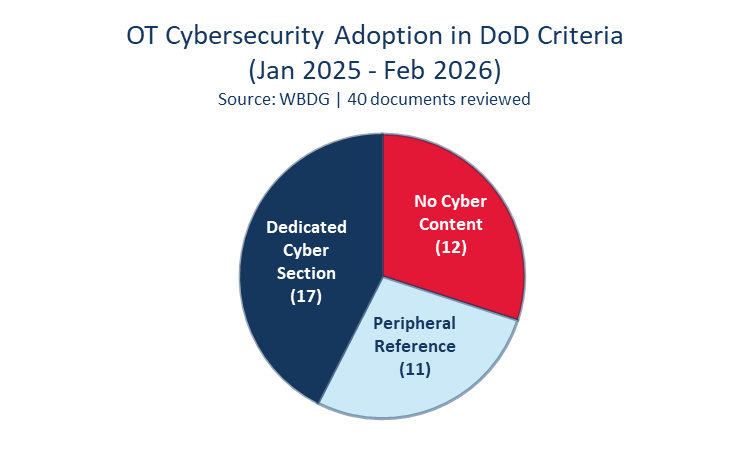
Recent federal facility criteria updates illustrate this shift. A February 2026 review of newly released UFM and UFS documents found that only one portion contained an explicit OT cybersecurity section referencing UFC 4-010-06—and those that did relied on identical boilerplate language directing readers back to that core standard. In other words, detailed technical requirements remain centralized and must be deliberately integrated during planning and design.
Pond’s experience supporting complex infrastructure and facility programs, particularly in federally regulated environments, informs a practical approach to OT cybersecurity that considers how operational systems are planned, designed, and sustained across their full lifecycle.
OT Cybersecurity in Federal Infrastructure in the Digital Age
Operational Technology refers to hardware and software used to monitor and control physical processes. Unlike information technology (IT), which primarily manages data and business systems, OT interacts directly with the physical world. In Department of Defense environments, many of these systems are formally categorized as Facility-Related Control Systems (FRCS), and they carry defined cybersecurity design requirements under UFC 4-010-06. Across military installations and federal facilities, common OT systems include:
Industrial control systems (ICS)
Supervisory Control and Data Acquisition (SCADA) systems
Building automation and management systems
In practical terms, OT systems are responsible for opening valves, regulating temperature, controlling traffic signals, and maintaining safe operating conditions. When these systems are disrupted, the consequences extend beyond data leaks or service disruptions; they can affect public trust and safety.
From Isolation to Exposure: How OT Systems Became Exposed to Cyber Risk
Early OT systems were isolated, off-grid physical control systems that lacked Wi-Fi, Bluetooth, or other ways of connecting to the internet. Instead, these systems relied on physical access (such as a USB drive) to get to the data. Cybersecurity was not a primary design consideration because connectivity was limited.
Today’s facilities and assets increasingly rely on networked systems to improve efficiency, visibility, and overall decision-making. Physical assets are now deeply intertwined with digital networks. As a result, cyber risk has expanded beyond traditional IT environments and into the operational systems that keep critical services running.
As infrastructure becomes more interconnected, OT cybersecurity is no longer a niche technical issue. It is a core consideration for federal agencies responsible for designing, delivering, and operating complex systems.
Why Federal Agencies Must Prioritize OT Cybersecurity from the Start
For federal agencies delivering infrastructure programs, OT cybersecurity cannot be treated as a downstream compliance task or post-construction add-on. DoD design criteria, including UFC 4-010-06, establish formal cybersecurity requirements for facility-related control systems. However, recent guidance documents do not list specific controls within each publication. Detailed requirements for segmentation, system boundaries, and access controls reside within the UFC itself and must be interpreted within project architecture decisions.
A reactive approach exposes agencies to avoidable risk and compliance challenges. Effective risk management begins when system architectures are defined, access pathways are established, and integration strategies are determined.
By prioritizing OT cybersecurity during planning and design, federal agencies can:
Reduce long-term risk exposure
Clarify responsibility between engineering and cybersecurity teams
Avoid costly retrofits
Strengthen resilience and mission assurance
Early OT cybersecurity integration helps infrastructure investments to be secure, compliant, and sustainable throughout their lifecycle.
Where OT Cybersecurity Fits in the Project Lifecycle
OT cybersecurity is often associated with operations, but planning, design, procurement, and system integration all influence how operational systems connect, how access is managed, and how risk is documented.
Key considerations may include:
System architecture and network segmentation
Vendor and integrator access controls
Documentation of cybersecurity requirements in contracts
Testing and transition into operations
Embedding cybersecurity within the project lifecycle supports proactive risk management and aligns infrastructure delivery with long-term performance and asset management goals. Recent federal criteria updates show variation in how cybersecurity is incorporated across facility documents. This inconsistency underscores the importance of subject matter expertise when interpreting requirements and aligning them with mission-critical infrastructure delivery.
Conclusion: OT Cybersecurity as a Core Infrastructure Consideration
OT cybersecurity reflects a fundamental shift in how infrastructure and facilities operate in a connected world. As physical systems become more digital, managing cyber risk becomes inseparable from managing operational risk.
For government and federal agencies, understanding the basics of OT cybersecurity is the starting point, not the finish line. As standards evolve and IT and OT systems continue to converge, cybersecurity must be treated as a core infrastructure design and lifecycle consideration. Organizations that integrate OT cybersecurity early—aligning architecture decisions with federal standards and secure-by-design principles—position themselves to strengthen resilience, maintain compliance, and protect mission continuity over the long term.
Pond’s multidisciplinary teams bring together engineers, cybersecurity specialists, and federal program experts to help agencies integrate OT cybersecurity into facility planning, modernization, and sustainment efforts. From aligning with federal frameworks to incorporating secure-by-design principles into mission-critical infrastructure, our approach is designed to strengthen operational resilience while supporting long-term program objectives.
Learn more about how Pond supports secure, resilient infrastructure across federal markets.