By clicking “Accept all”, you agree to storing cookies on your device to enhance site navigation, analyze site usage, and assist in our marketing efforts. More information can be found on "Manage cookies".
When you visit any website, it may store or retrieve information on your browser, mostly in the form of cookies. These “cookies” of information might be about you, your preferences, or your device, and they’re mostly used to make the site work as you expect it to. Cookies don’t usually directly identify you, but they can give you a more personalized web experience. Because we respect your right to privacy, you can choose not to allow some types of cookies. Click on the category headings to read more or change your default settings. (Note: Blocking some types of cookies may impact your experience on our site, as well as the services we can offer you.)
These cookies are necessary for our website to function and can’t be switched off in our systems. They’re set for you behind the scenes when you do things such as log in, fill out forms, make a request for services, or set your privacy preferences. You can set your browser to block or alert you about these cookies, but some parts of our site won’t work without them.
+Functional Cookies
These cookies enable our website to work smoothly and in a manner personalized to you. They may be set by us or by third-party providers whose services we’ve added to our pages. For example; downloading a customer service form using PDF. If these cookies are blocked, then some or all of these services may not function.
+Performance Cookies
These cookies allow us to count how many times people visit our website, and how they get here, so we can measure and improve its performance. They show us which pages are the most (and least) popular, and how visitors move around on the site when they’re here. If you don’t allow performance cookies, we have less information about how to improve our sites that will be useful to you.
+Marketing Cookies
These cookies may be set through our site by our advertising partners. They may be used by those companies to build a profile of your interests and show you relevant advertisements on other sites. If these cookies are blocked, you will experience less targeted advertising.
From Siting to Sightlines: How FAA Siting Studies Shape Modern Airport Traffic Control Towers
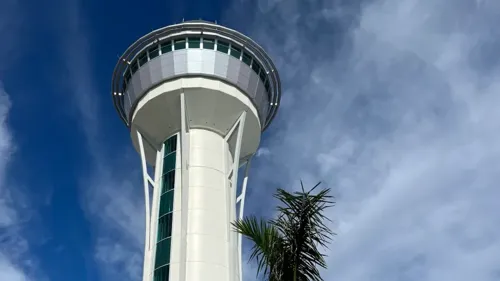
At first glance, the location of an airport traffic control tower (ATCT) may appear arbitrary. The reality is that an analytical siting process determines not only where a new tower can be placed, but how tall it must be, and how it will function within the broader National Airspace System.
These decisions are guided by the FAA’s current Airport Traffic Control Tower Siting Order (Order 6480.4C), which evaluates criteria relating to:
Instrument procedures and airport design standards
Communications, navigation, surveillance, and weather equipment
Visibility performance
Safety analysis
Operational requirements
Environmental and economic considerations
This evaluation is rigorous, multidisciplinary, and data driven. It combines formal safety review with advanced 3-D modeling tools that allow stakeholders to validate siting decisions before the design advances to construction.
The first blog in this ATCT design series demonstrated Pond’s ability to bring ATCTs to life and identified siting as one of the most critical phases. Here, we’ll dive deeper and explain what the FAA siting study evaluates and why the result becomes a long-term blueprint for how the facility operates.
Protecting Instrument Procedures and Critical Infrastructure
Instrument procedures and critical infrastructure are the airport’s safety backbone. Getting this first part right enables the airport to safely operate today, while keeping options open for future growth.
When conducting a siting assessment, candidate sites must be evaluated for impacts to:
Existing and planned terminal instrument procedures (TERPS)
Applicable federal regulations and airport design standards
Communications, navigation, surveillance, and weather equipment
Three sites in diverse areas of the airport must be included in the assessment. Though a particular site may be preferred for safety, operations, cost, constructability, or other criteria, this could change based on evaluations completed after siting.
Visibility Performance Requirements
With airspace and system impacts addressed, the next greatest emphasis is on visibility performance. These requirements include:
Line-of-sight to runways, taxiways, and controlled movement areas
Object detection capability at distance
Line-of-sight angle of incidence, minimum 0.80 degrees
Two-point lateral discrimination, minimum 0.13 degrees at critical points
Dynamic visibility of both moving and parked aircraft
Visibility performance directly influences tower height, placement, and cab orientation. A minor relocation can significantly improve visibility at runway intersections or closely spaced taxiways. In some cases, a modest shift in location reduces the required height. In others, increased elevation is necessary for controllers to reliably distinguish what they’re seeing on the movement area.
Safety Risk Management (SRM) Process
With safety woven into the way aviation operates and evolves, the FAA utilizes a safety framework structured around describing the system; identifying the hazards; and analyzing, assessing, and treating risk.
In a siting study, that means every criterion must be examined through a hazard lens, with each preferred location evaluated and, where necessary, mitigations put in place until the remaining risk meets acceptable SRM standards.
Operational Requirements
To support efficient use of airspace and the movement area, the ATCT should be built at the lowest height that still meets all required operational visibility and performance standards outlined by the FAA.
Cab orientation is also critical. In the northern hemisphere, the ATCT should be oriented so the primary view of the movement area faces north, which keeps the main sightline pointed away from the sun for most of the day and year. If a north-facing orientation isn’t feasible, the preferred alternatives are east or west, and lastly south.
In addition to glares, thermal distortion and external light sources, the siting criteria must also contemplate:
Recurring fog, haze, and seasonal weather patterns
Look-up and look-down angles
Look-across LOS created by cab size
Cab column placement and interior obstructions
LOS from the existing ATCT during construction of a new tower
Visibility of all airport surfaces for ground operations
Cab size
Site access that avoids interference with aircraft operations
Environmental and economic considerations
Environmental and economic impacts are the final criteria to be evaluated. In addition to environmental due diligence, cost estimates must be documented for each of the preferred sites, based on tower height, land use planning, utilities and cabling, any new or redesigned site access roadways, site grading, and required stormwater provisions.
Finally, risk mitigation strategies should reflect the fiscal implications identified through safety analysis, environmental site assessment, and comparative environmental resource screening. By aligning environmental insight with financial planning, stakeholders move forward with a tower site grounded in both practicality and long-term value.
Reducing Risk Through Early, Informed Siting Decisions
ATCT siting is fundamentally a risk management exercise. Decisions made early in the process can significantly reduce downstream challenges during design, construction, and commissioning by rigorously evaluating visibility, operational conditions, and site constraints upfront. Siting studies help:
Minimize late-stage redesigns
Reduce the likelihood of FAA rework or approval delays
Improve cost and schedule predictability
Support smoother transitions from existing towers to new facilities
Pond’s integrated approach, combining FAA-mandated analyses with advanced visualization and, when appropriate, physical testing, helps identify and mitigate risks while design flexibility is still high.
How Pond Uses VR and 3-D Modeling to Validate Siting Decisions
Given the complexity of ATCT siting decisions, visualization and simulation tools play a critical role in site identification. The FAA employs multiple methods to evaluate proposed tower sites, including modeling conducted at the Airport Facilities Terminal Integration Laboratory (AFTIL) and the Virtual Immersive Siting Tower Assessment (VISTA), which evaluates ATCT visibility and operational performance in a virtual environment.
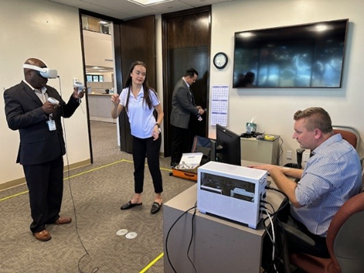
Building on these FAA-established approaches, Pond’s in-house visualization and virtual reality (VR) capabilities are structured around the same principles that underpin VISTA. Using immersive, computer-generated environments, Pond translates siting criteria into a controller’s-eye view of the airfield, incorporating terrain, existing and future airport development, cab geometry, and operational positions. These tools allow teams to:
Adjust cab height in real time
Rotate orientation to evaluate glare and sightlines
Test column configurations
Toggle future development on and off
Simulate aircraft movement and lighting conditions
Pond leverages UrbanViz, its proprietary visualization and VR platform, to place FAA reviewers, airport sponsors, and project teams directly inside the proposed ATCT cab. These simulations model real-world conditions, providing early insight into how tower height, location, and orientation affect day-to-day operations, when adjustments remain both feasible and cost-effective.
The resulting 3-D model also provides long-term value. As airports expand, it can be used to evaluate potential line-of-sight impacts from new facilities, supporting proactive planning decisions.
Case Study: Gary/Chicago International Airport
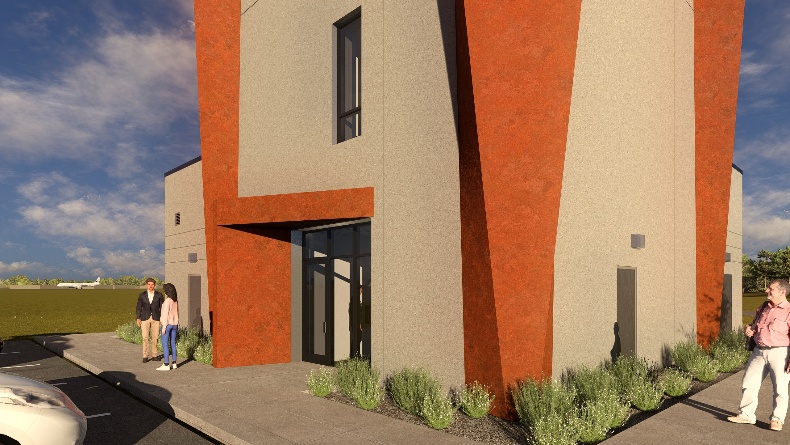
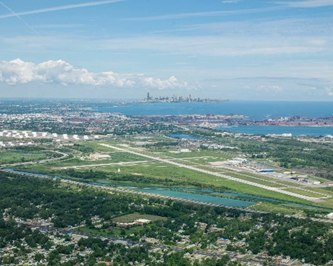
Gary/Chicago International Airport illustrates how a disciplined siting process informs overall project success.
Located within the Chicago metropolitan area, GYY functions as an important reliever airport, operating within a complex regional airspace environment. As airfield operations evolved, the existing control tower became increasingly inefficient and no longer supported the demands of the airport.
Pond was engaged to support the siting and design of a new Tower, beginning with a detailed evaluation of performance, usability, and lifecycle cost. Through detailed modeling, VR simulation and structured analysis, the team identified a tower height and location that improved sightlines across critical movement areas while remaining compatible with instrument procedures and surrounding infrastructure.
Internally, the tower layout reflects the validated siting assumptions, with the cab positioned to provide 360-degree visibility across confirmed sightlines.
This project reflects Pond’s integrated approach using siting analysis not as a standalone exercise, but as the framework that guides design decisions and supports safe, efficient air traffic operations for decades to come.
Pond’s Role: Bridging Technical Analysis and Sponsor Decision-Making
ATCT siting studies involve regulatory coordination, quantitative modeling, and multidisciplinary review. For airport sponsors, translating that analysis into clear, strategic decisions can be complex.
Pond works alongside sponsors and FAA stakeholders to interpret siting criteria, clarify tradeoffs, and align technical findings with operational priorities. Whether evaluating height implications, resolving procedural constraints, or visualizing sightlines in an immersive environment, our role is to connect technical analysis with practical outcomes.
By integrating airspace analysis, safety facilitation, advanced modeling, and design expertise, Pond supports siting decisions that are defensible, transparent, and grounded in operational reality.
Conclusion: Why Siting Decisions Mater Long After Construction
An FAA siting study establishes the framework for every ATCT project. Decisions made during this phase influence controller effectiveness, construction cost, and an airport’s ability to adapt to future development.
Successful siting is not defined by a single metric. It requires integrating regulatory criteria, operational insight, safety analysis, and advanced modeling into a cohesive recommendation.
By approaching siting as a disciplined systems evaluation rather than simply a question of height and visibility, airport sponsors position their tower projects for long-term performance and resilience. Pond partners with airports and aviation stakeholders to guide this process, helping to transform complex airfield constraints into strategic, future-ready ATCT solutions. Learn more about Pond’s full-service aviation expertise.


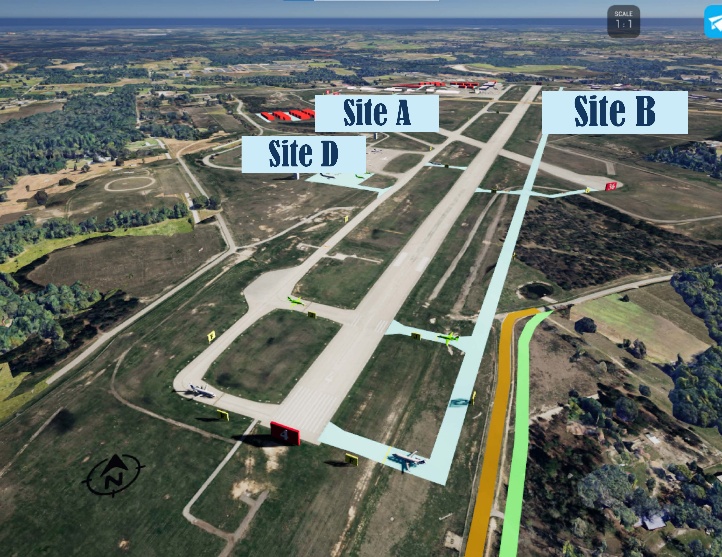 Protecting Instrument Procedures and Critical Infrastructure
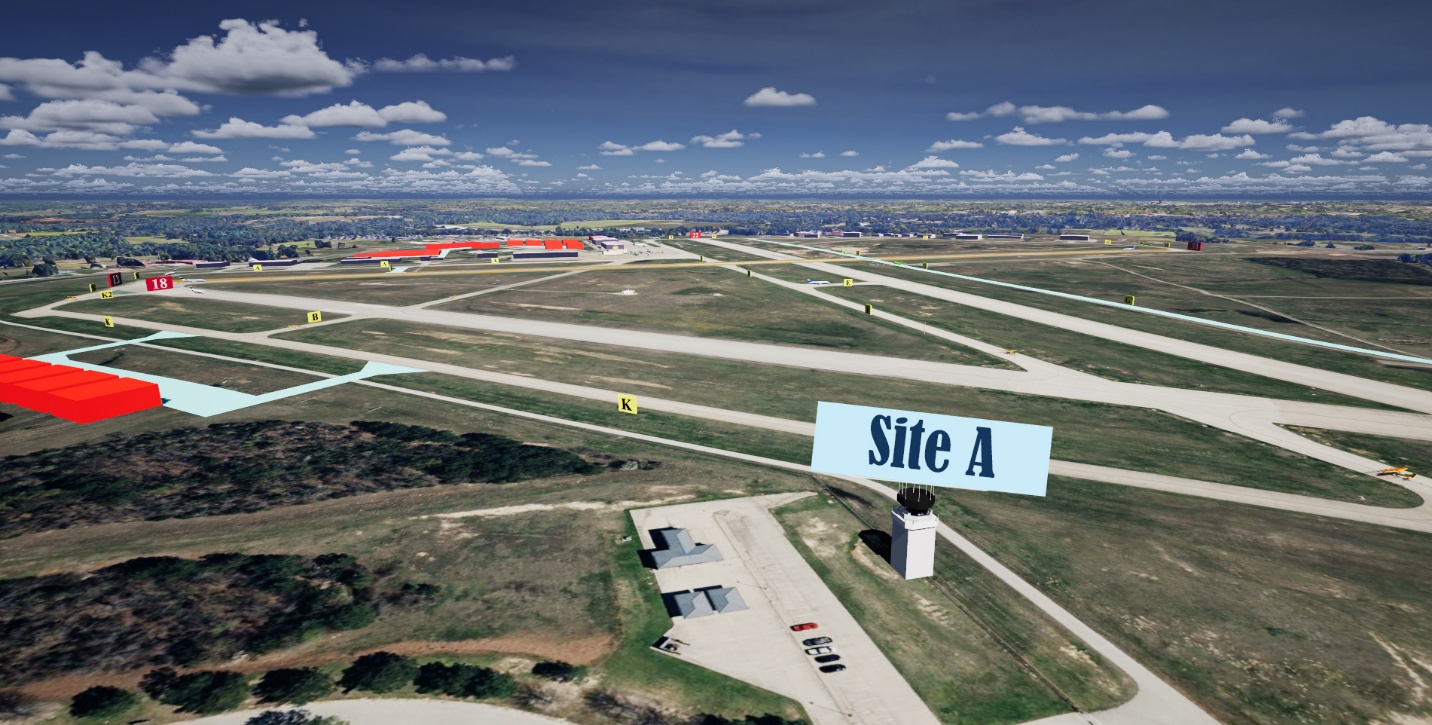 Cab orientation is also critical. In the northern hemisphere, the ATCT should be oriented so the primary view of the movement area faces north, which keeps the main sightline pointed away from the sun for most of the day and year. If a north-facing orientation isn’t feasible, the preferred alternatives are east or west, and lastly south.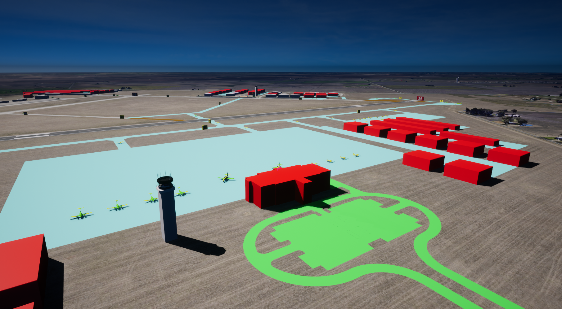
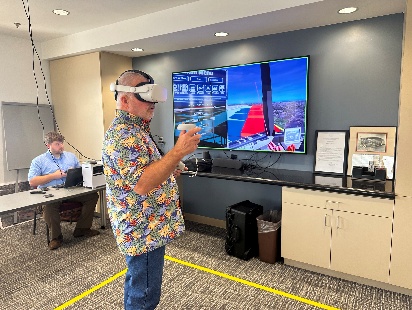
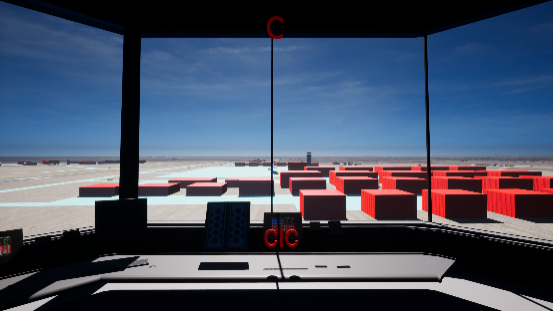 Given the complexity of ATCT siting decisions, visualization and simulation tools play a critical role in site identification. The FAA employs multiple methods to evaluate proposed tower sites, including modeling conducted at the Airport Facilities Terminal Integration Laboratory (AFTIL) and the Virtual Immersive Siting Tower Assessment (VISTA), which evaluates ATCT visibility and operational performance in a virtual environment.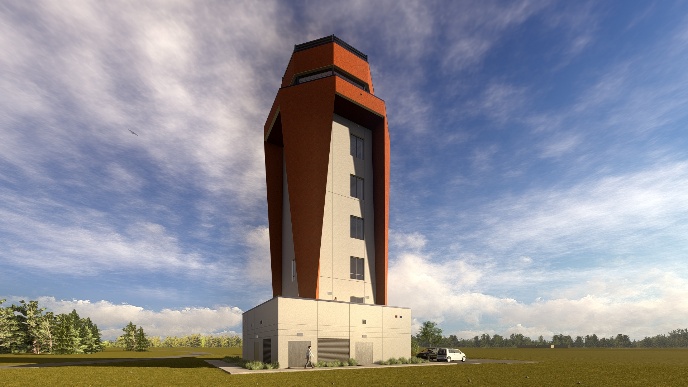
 Gary/Chicago International Airport illustrates how a disciplined siting process informs overall project success.