By clicking “Accept all”, you agree to storing cookies on your device to enhance site navigation, analyze site usage, and assist in our marketing efforts. More information can be found on "Manage cookies".
When you visit any website, it may store or retrieve information on your browser, mostly in the form of cookies. These “cookies” of information might be about you, your preferences, or your device, and they’re mostly used to make the site work as you expect it to. Cookies don’t usually directly identify you, but they can give you a more personalized web experience. Because we respect your right to privacy, you can choose not to allow some types of cookies. Click on the category headings to read more or change your default settings. (Note: Blocking some types of cookies may impact your experience on our site, as well as the services we can offer you.)
These cookies are necessary for our website to function and can’t be switched off in our systems. They’re set for you behind the scenes when you do things such as log in, fill out forms, make a request for services, or set your privacy preferences. You can set your browser to block or alert you about these cookies, but some parts of our site won’t work without them.
+Functional Cookies
These cookies enable our website to work smoothly and in a manner personalized to you. They may be set by us or by third-party providers whose services we’ve added to our pages. For example; downloading a customer service form using PDF. If these cookies are blocked, then some or all of these services may not function.
+Performance Cookies
These cookies allow us to count how many times people visit our website, and how they get here, so we can measure and improve its performance. They show us which pages are the most (and least) popular, and how visitors move around on the site when they’re here. If you don’t allow performance cookies, we have less information about how to improve our sites that will be useful to you.
+Marketing Cookies
These cookies may be set through our site by our advertising partners. They may be used by those companies to build a profile of your interests and show you relevant advertisements on other sites. If these cookies are blocked, you will experience less targeted advertising.
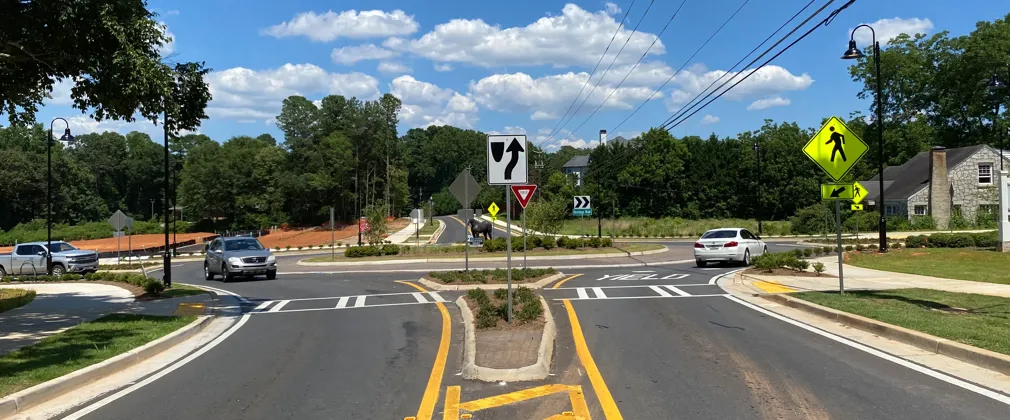
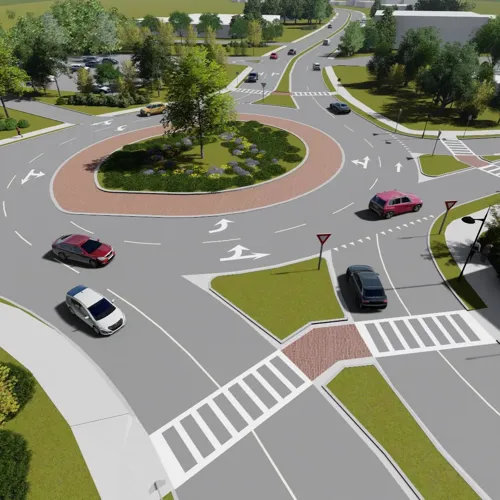
Pond led the design of the Crabapple Connector which included a roundabout at Bethany Bend/Bethany Way at Hopewell Road. On the surface, the Crabapple Connector appears to be mostly about providing congestion relief for those who drive through the City of Milton.
In reality, this project is much more dynamic for Milton's citizens and visitors, providing critical walkability connections to the east side of downtown, access to planned developments in the city, and reinforcing a sense of place for the community. Through the city's placemaking plan, the downtown area was identified as an auto-centric roadway network that lacked pedestrian accessibility and required a sense of community. This, coupled with growing traffic congestion at the existing crossroads intersection of Birmingham Hwy/Crabapple Road/Broadwell Road/Mayfield Road, created the need for the Crabapple Connector project.
The City of Milton selected Pond to provide a context-sensitive design solution to address these dynamic needs. Pond began by completing a traffic analysis and evaluating different intersection solutions, resulting in the selection of the roundabout for better traffic flow and improved vehicular and pedestrian safety. In addition to the roundabout, the project includes ADA features at the roundabout and sidewalks along the new connector. On-street parking is also included along the connector, creating an additional buffer between sidewalk locations and vehicular traffic that enhances pedestrians' actual and perceived safety.
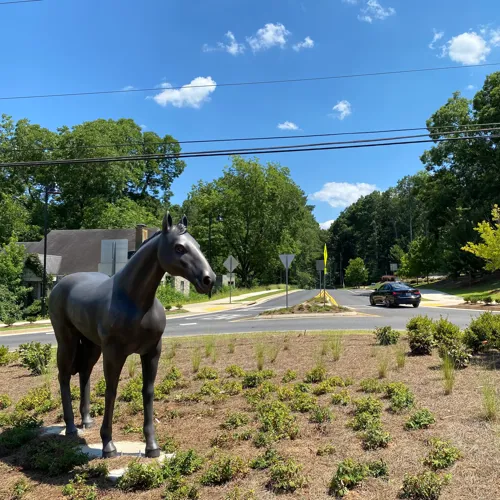
Pond worked with the city to evaluate design elements that would establish a unique sense of place. A centerpiece horse statue proudly stands in the center of the roundabout, honoring the city's equestrian heritage while memorializing beloved city employee Mark Law. This project is a great example of how a context-sensitive design can transform an otherwise simple intersection improvement project to benefit the community, with improved traffic operations, enhanced vehicular and pedestrian safety, supported planned development, and creates a distinct sense of place.